The Kenya Revenue Authority (KRA) wants wider powers to access personal and third-party information to help collect taxes under the proposed Finance Bill 2026.
The proposed changes are included in the Draft Finance Bill 2026 and may allow KRA to use information from different digital and government systems to calculate a person’s taxes, even if the taxpayer has already filed returns.
If approved, the new law will change Kenya’s current self-assessment tax system and give KRA more authority to use technology and data in tax enforcement.
According to the proposed Section 18A of the Tax Procedures Act, the KRA Commissioner will have powers to investigate and determine whether a person or company is involved in tax avoidance schemes.
The proposal says KRA may calculate taxes as if the tax avoidance arrangement never happened.
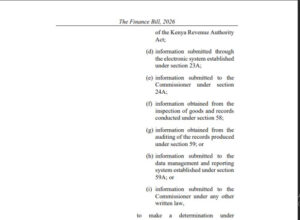
screengrab of a section of the draft finance bill 2026.
The draft law also states that KRA can use information collected from several sources, including employer payroll records, withholding tax reports, electronic tax invoice systems, audit reports, whistleblower reports, and information submitted under other laws.
This means KRA may combine data from government systems and digital platforms to estimate a taxpayer’s income and tax obligations.
Tax experts have raised concerns over the proposed law, saying it may increase KRA’s powers too much and expose taxpayers to unfair tax assessments.
The Finance Bill also introduces a new Section 29A, which would allow the Commissioner to issue tax assessments using information collected from digital tax systems and third parties.
Another major proposal in the Bill is allowing KRA to prepare pre-filled tax returns for taxpayers.
Under the proposed changes to Section 75 of the Tax Procedures Act, KRA may use technology systems to generate tax returns on behalf of taxpayers using available information.
Taxpayers will then review and submit the prepopulated returns instead of filling in all details manually.
The government says the new measures are meant to improve tax collection, reduce tax evasion, and increase efficiency in tax administration as the country faces financial pressure and growing public debt.
However, some analysts warn that the system may rely on incorrect or incomplete data from third parties, which could lead to disputes between taxpayers and KRA.
There are also concerns about transparency, especially where information comes from whistleblowers or external digital systems that taxpayers may not easily verify.
The proposed law defines a “tax benefit” as anything that reduces the amount of tax a person should pay, delays tax payment, or leads to a tax refund.
Critics argue that the wording is too broad and may allow KRA to treat normal tax planning as tax avoidance.
The Bill also proposes giving KRA up to five years to issue tax assessments related to such cases.
At the same time, KRA continues to expand the use of digital platforms such as eTIMS, iTax, and electronic payment monitoring systems to track business transactions across the country.
The Finance Bill 2026 also introduces tougher reporting rules for virtual asset service providers, requiring them to submit detailed reports on users and transactions.
Treasury officials say the changes are part of efforts to modernise Kenya’s tax system and match global digital tax enforcement trends.
Business groups and tax experts are now expected to push for stronger safeguards and better taxpayer protection before Parliament debates and approves the final Bill.

 Click to Join Our WhatsApp Channel